
Navigating complex Durable Medical Equipment, Prosthetics, Orthotics, and Supplies (DMEPOS) audits requires more than maintaining basic business records. Healthcare suppliers must demonstrate that every product provided, service delivered, and Medicare claim submitted is supported by accurate documentation and complies with applicable regulatory requirements. As healthcare oversight continues to evolve, DMEPOS providers must establish effective compliance strategies to minimize financial risks, prevent billing errors, and maintain operational stability.
Audits can be challenging because they often involve multiple areas of business operations, including medical necessity, prescription requirements, proof of delivery, coding accuracy, and supplier documentation. Even minor inconsistencies between patient records and submitted claims can create significant compliance concerns.
Understanding how audits work and preparing for them proactively allows DMEPOS businesses to protect their revenue, strengthen internal processes, and maintain confidence among patients, healthcare professionals, and regulatory organizations.
Understanding the DMEPOS Audit Process
What Makes DMEPOS Audits Complex
DMEPOS audits evaluate whether suppliers meet applicable Medicare coverage, billing, documentation, and supplier requirements. Depending on the review, auditors may examine individual claims, medical records, business processes, and supporting evidence associated with supplied equipment.
The complexity often comes from the different documentation requirements associated with specific products and services. A standard written order may be necessary for a claim, while certain items may also require additional face-to-face encounter documentation or a written order before delivery.
Auditors may identify concerns such as:
- Missing or incomplete medical records.
- Inadequate evidence of medical necessity.
- Incorrect billing codes or modifiers.
- Missing proof of delivery.
- Inconsistent patient information.
- Documentation that does not support the billed equipment.
- Failure to meet applicable coverage criteria.
Common Types of DMEPOS Reviews
Suppliers may encounter different forms of Medicare oversight, including claims reviews, medical record reviews, and investigations conducted by authorized program integrity organizations.
The scope of a review can vary. Some reviews focus on specific claims, while others examine broader billing patterns or potential compliance risks.
Understanding the purpose and scope of an audit is the first step toward developing an appropriate response.
Building an Audit-Ready Documentation System
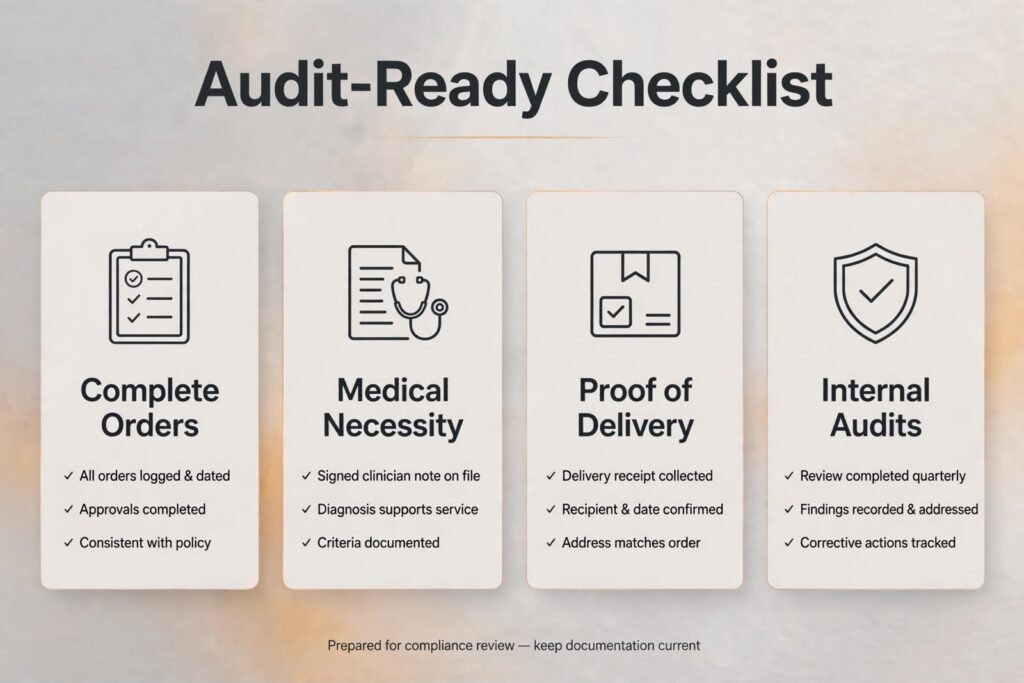
Maintaining Complete Standard Written Orders
A Standard Written Order (SWO) is an essential component of Medicare DMEPOS documentation. Suppliers should verify that orders contain the required information, including the beneficiary’s name or Medicare Beneficiary Identifier, the order date, a description of the item, the applicable quantity, and the treating practitioner’s name or required identification.
The order must also satisfy applicable timing requirements. Certain products are subject to Written Order Prior to Delivery (WOPD) requirements, making it important to identify those products before delivery.
An organized order management process helps suppliers prevent missing information and reduce unnecessary claim complications.
Establishing Medical Necessity
Medical necessity is one of the most important areas examined during DMEPOS audits.
Documentation should establish why a particular product or service is appropriate for the beneficiary’s medical condition. Relevant information may include clinical assessments, physician notes, diagnostic findings, treatment plans, and other supporting medical records.
A prescription alone does not automatically establish that every Medicare coverage requirement has been satisfied. Suppliers should review applicable National Coverage Determinations (NCDs), Local Coverage Determinations (LCDs), and related policy articles before billing.
Organizing Proof of Delivery Records
Proof of Delivery (POD) demonstrates that the beneficiary received the equipment or supplies associated with a claim.
A complete delivery process should capture the required information, including the beneficiary’s identity, the items delivered, relevant dates, and appropriate delivery confirmation.
Businesses should also establish procedures for tracking shipments, documenting delivery exceptions, and resolving discrepancies between shipping records and billing information.
Maintaining Accurate Patient and Claim Records
Patient records should be organized so that auditors can easily connect the prescription, medical documentation, delivered product, and submitted claim.
A centralized documentation system can reduce administrative delays and improve the accuracy of information retrieved during an audit.
Risk Management Strategies for DMEPOS Suppliers
Identifying Compliance Risks Before They Become Problems
Effective risk management begins with identifying weaknesses in daily operations.
Common risk areas include inconsistent documentation, insufficient employee training, outdated billing procedures, inaccurate coding, and inadequate communication between departments.
A structured risk assessment should evaluate the entire patient service process, from initial intake through product delivery and claim submission.
Implementing Internal Audit Programs
Internal audits allow suppliers to identify documentation and billing problems before external reviewers discover them.
A practical internal audit program should include:
- Reviewing a representative sample of claims.
- Verifying that required orders are complete.
- Confirming that medical records support medical necessity.
- Checking applicable coding and coverage requirements.
- Reviewing proof of delivery.
- Documenting identified deficiencies.
- Assigning corrective actions and monitoring completion.
The frequency and scope of internal reviews should reflect the organization’s size, product categories, billing volume, and identified risk levels.
Strengthening Employee Training
Employees involved in intake, billing, documentation, delivery, and compliance should understand their responsibilities.
Regular training helps staff recognize documentation requirements, follow updated procedures, and avoid common administrative mistakes.
Training should also address how to respond to audit requests, protect confidential patient information, and escalate potential compliance concerns.
Establishing Clear Accountability
Assigning compliance responsibilities to designated personnel improves consistency across business operations.
Management should establish written procedures, define approval responsibilities, and monitor whether employees follow established policies.
Clear accountability also makes it easier to investigate problems and implement corrective actions.
Regulatory Preparedness and Compliance Management
Monitoring CMS Regulatory Updates
DMEPOS suppliers must remain informed about changes in Medicare regulations, coverage policies, documentation standards, and billing instructions.
The Centers for Medicare & Medicaid Services (CMS) publishes guidance that helps suppliers understand applicable requirements.
Businesses should regularly review the Medicare Program Integrity Manual, DMEPOS quality standards, relevant LCDs, and official Medicare guidance.
Understanding Record Retention Requirements
Proper record retention is essential when preparing for an audit.
CMS guidance specifies that suppliers must maintain proof of delivery documentation for seven years from the date of service. Suppliers should also follow applicable requirements for retaining other supporting records and any additional federal or state obligations.
Digital document management systems can improve retrieval speed, reduce the risk of lost records, and support consistent record organization.
Preparing an Effective Audit Response
When an audit request arrives, suppliers should first identify the reviewing organization, applicable claims, requested records, and submission deadline.
A designated audit response team should coordinate document collection and verify that the submitted information is complete and accurate.
Businesses should avoid altering original documentation or creating retrospective records that could misrepresent when information was originally recorded. Any permitted clarification or amendment must follow applicable documentation policies and maintain a transparent audit trail.
Leveraging Technology to Improve Audit Readiness
Electronic Document Management Systems
Electronic document management systems help suppliers organize prescriptions, medical records, delivery confirmations, billing information, and audit correspondence.
Searchable records allow authorized employees to retrieve relevant documents more efficiently.
Automated Compliance Monitoring
Automation can help identify missing signatures, incomplete orders, unusual billing patterns, and documentation gaps.
Automated alerts can also remind employees about outstanding records and upcoming compliance reviews.
However, technology should support rather than replace professional oversight. Human review remains important for evaluating medical necessity, interpreting policy requirements, and resolving complex documentation questions.
Data Security and Access Controls
DMEPOS suppliers handle sensitive patient information and must maintain appropriate safeguards.
Access controls, secure storage, employee permissions, audit logs, and backup procedures can help protect records while supporting operational continuity.
The Financial Impact of Audit Preparedness
Audit readiness is not simply a regulatory responsibility. It is also an important financial management strategy.
Incomplete records and unsupported claims can lead to payment delays, denials, repayment obligations, and additional administrative expenses.
A proactive compliance program helps businesses identify preventable errors, reduce rework, and improve the reliability of their revenue cycle.
Suppliers should also monitor audit-related performance indicators, such as documentation completion rates, claim denial patterns, response times, and corrective action completion.
Conclusion
Navigating complex DMEPOS audits requires a coordinated approach to documentation, risk management, and regulatory preparedness. Suppliers that maintain complete medical records, verify billing accuracy, establish internal audit programs, and monitor regulatory changes are better positioned to respond to external reviews.
By investing in employee training, reliable technology, and consistent compliance procedures, DMEPOS businesses can reduce operational risks while protecting their financial stability.
Ultimately, audit preparedness should become part of everyday business operations rather than an activity that begins only after receiving an audit notice. A well-organized compliance framework supports responsible healthcare delivery, stronger business performance, and long-term organizational growth.
Frequently Asked Questions (FAQs)
1. What is a DMEPOS audit?
A DMEPOS audit is a review of durable medical equipment, prosthetics, orthotics, and supplies claims and supporting records to determine whether applicable coverage, documentation, coding, and billing requirements have been satisfied.
2. What documents are commonly required during a DMEPOS audit?
Commonly requested records include standard written orders, medical records supporting medical necessity, proof of delivery, claim information, applicable certificates or forms, and additional documentation required by specific coverage policies.
3. How long should DMEPOS suppliers retain proof of delivery records?
CMS guidance requires suppliers to maintain proof of delivery documentation for seven years from the date of service.
4. Why is medical necessity important in DMEPOS audits?
Medical necessity establishes that the equipment or supplies are appropriate for the beneficiary’s medical condition and satisfy applicable Medicare coverage requirements.
5. How can DMEPOS suppliers reduce audit risks?
Suppliers can reduce audit risks through regular internal audits, complete documentation, accurate coding, employee training, secure record management, and ongoing regulatory monitoring.
6. What is a Standard Written Order?
A Standard Written Order is a written order from an authorized treating practitioner that contains the information required under applicable Medicare DMEPOS documentation rules.
7. What happens if a DMEPOS supplier cannot provide requested records?
Missing or insufficient documentation may result in claim denials, overpayment determinations, repayment obligations, or additional compliance review, depending on the circumstances.
8. How does technology improve DMEPOS audit preparedness?
Electronic records, automated documentation checks, secure storage, and compliance monitoring tools help suppliers organize information, identify errors, and respond to audit requests more efficiently.
9. What role do internal audits play in compliance?
Internal audits help identify documentation gaps, coding mistakes, and operational weaknesses before they become larger regulatory or financial problems.
10. How often should a DMEPOS business review its compliance procedures?
Compliance procedures should be monitored continuously, with scheduled internal reviews based on business risks, operational changes, applicable regulations, and audit findings.