
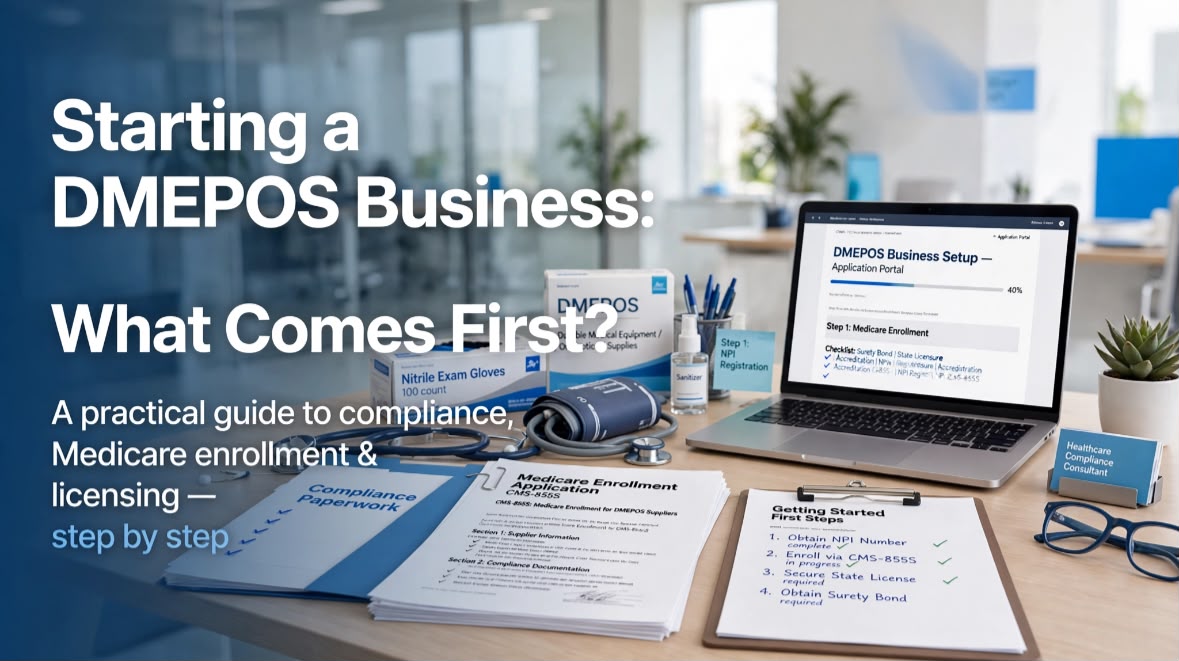
Launching a DMEPOS business involves several important decisions, from choosing the equipment and supplies you will offer to preparing your business for Medicare participation. Among the first compliance questions is whether to complete DMEPOS accreditation or submit a Medicare enrollment application.
Getting the order right matters. Accreditation and enrollment are separate processes, and completing one does not automatically satisfy the requirements of the other.
For most suppliers that are subject to accreditation requirements, DMEPOS accreditation must be obtained before the Medicare enrollment application is submitted. Understanding this requirement early can help business owners plan their launch, organize documentation, and avoid unnecessary application delays.
Understanding the Difference Between Accreditation and Enrollment
Although accreditation and Medicare enrollment are closely connected, they evaluate different aspects of a DMEPOS business.
DMEPOS Accreditation Focuses on Quality and Compliance
Accreditation evaluates whether a supplier meets the applicable DMEPOS quality standards through a CMS-approved accreditation organization.
These standards may address business administration, staff responsibilities, customer service, recordkeeping, product safety, and the procedures used to furnish equipment and supplies.
The accreditation organization evaluates the supplier’s readiness and determines whether the required standards have been met.
Medicare Enrollment Establishes Eligibility to Bill Medicare
Medicare enrollment is a separate administrative and eligibility process. The enrollment contractor reviews the supplier’s application and verifies whether the business meets the applicable Medicare supplier requirements.
The application includes information about ownership, business operations, practice locations, and other required details.
A supplier should therefore treat accreditation as one essential part of the overall compliance process, rather than as a substitute for Medicare enrollment.
Why Accreditation Generally Comes First
The accreditation requirement is designed to ensure that covered DMEPOS suppliers meet applicable quality standards before applying for Medicare billing privileges.
Submitting an application without the required accreditation may result in denial or processing problems. This can create additional work for a new business that is already managing licensing, staffing, documentation, and startup costs.
However, accreditation requirements do not apply identically to every supplier category. Certain eligible professionals and other specified categories may be exempt.
Before selecting an accreditation organization, confirm whether your business requires accreditation and which products and services must be covered.
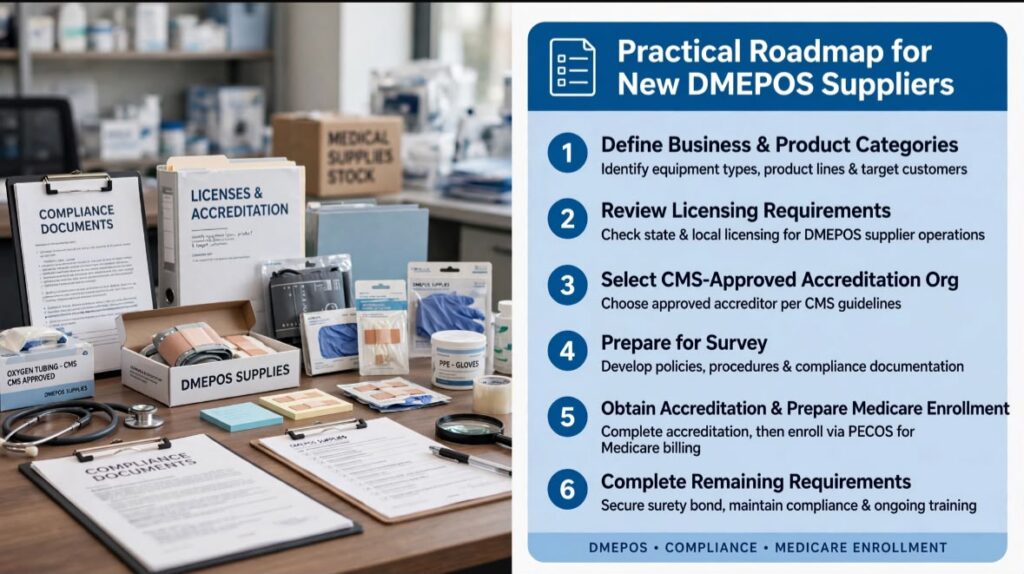
A Practical Roadmap for New DMEPOS Suppliers
Step 1: Define Your Business and Product Categories
Determine which equipment, prosthetics, orthotics, or medical supplies your business intends to furnish.
Your product categories can affect accreditation scope, licensing requirements, operational procedures, and the information you need to provide during enrollment.
Avoid preparing an application based on an incomplete understanding of your intended services.
Step 2: Review Licensing and Business Requirements
Check the applicable state and local requirements for your business type and product categories. Prepare the relevant business, ownership, and location records.
The required documents can vary depending on the supplier’s structure, location, and operations.
Step 3: Select a CMS-Approved Accreditation Organization
Choose an organization approved by CMS for the applicable DMEPOS accreditation program.
Confirm that it covers your intended products and services and ask about its current application process, survey requirements, fees, and expected preparation steps.
Do not rely solely on an organization’s general accreditation services; verify its current CMS approval and relevant scope.
Step 4: Prepare for the Accreditation Survey
Develop the policies and procedures needed to demonstrate compliance with applicable quality standards.
Preparation may include reviewing employee responsibilities, maintaining required records, establishing customer service procedures, and ensuring that the business is ready for the required survey.
Accreditation should reflect actual compliance, not merely the completion of paperwork.
Step 5: Obtain Accreditation and Prepare Your Medicare Enrollment
Once the required accreditation is obtained, prepare your Medicare enrollment application.
Covered suppliers generally use CMS-855S through PECOS or an applicable paper application. Verify the correct NPI information for each relevant location and ensure that business details match the supporting documentation.
Step 6: Complete the Remaining Medicare Requirements
Respond promptly to enrollment contractor requests. Complete applicable fee, surety bond, and other supplier requirements.
Remember that the application process is not complete simply because the accreditation certificate has been issued or the enrollment application has been submitted.
What Can Delay DMEPOS Accreditation and Enrollment?
Incomplete Policies and Records
Missing procedures, inconsistent documentation, or unclear staff responsibilities may create problems during accreditation preparation and review.
Incorrect Product or Service Information
The products and services covered by accreditation should align with the supplier’s intended operations and enrollment information.
Changes to product categories may require additional coordination with the accreditation organization and enrollment contractor.
Errors in Location and NPI Details
Incorrect location information or missing NPI details can complicate the enrollment review. Suppliers with multiple locations should verify the requirements that apply to each site.
Assuming Accreditation Means Approval
Accreditation does not guarantee Medicare enrollment. Suppliers must satisfy all other applicable enrollment requirements and receive the necessary approval before billing Medicare.
How Can All State Support DMEPOS Businesses?
DMEPOS suppliers may need to coordinate several activities at the same time, including accreditation preparation, licensing, business documentation, and Medicare enrollment.
Professional support can help business owners understand the sequence, identify missing documentation, and organize the information needed for each stage.
When evaluating a consultant, ask about their experience with DMEPOS suppliers, the specific services included, fees, and responsibilities. Confirm that any guidance reflects current CMS requirements.
A well-organized plan can make the process easier to manage, but approval decisions remain with the relevant accreditation and Medicare enrollment authorities.
Frequently Asked Questions
What should I do first when starting a DMEPOS business?
Start by identifying your products and services, confirming the applicable licensing and accreditation requirements, and preparing your business documentation. Covered suppliers generally need accreditation before submitting their Medicare enrollment application.
Can I start preparing my Medicare application while accreditation is underway?
You can generally organize documents, verify NPI information, and prepare business details in advance. However, suppliers subject to accreditation requirements should not submit the Medicare enrollment application before obtaining the required accreditation.
Is accreditation the same as a Medicare supplier number?
No. Accreditation confirms compliance with applicable quality standards, while Medicare enrollment establishes eligibility for the relevant billing privileges. They are separate processes.
Do new DMEPOS locations need separate accreditation?
Applicable requirements generally address each supplier location separately. New locations may require a survey before accreditation, and each location must satisfy the relevant enrollment requirements. Confirm the current rules before opening an additional site.
How can I avoid delays during the process?
Verify your accreditation requirements, prepare complete documentation, maintain consistent business information, and respond promptly to requests from the accreditation organization or enrollment contractor.
Can an accreditation consultant guarantee Medicare enrollment approval?
No. A consultant may assist with preparation and documentation, but cannot guarantee that CMS or its enrollment contractor will approve an application.
Conclusion
For most DMEPOS suppliers, the process begins with understanding accreditation requirements and obtaining the necessary accreditation before submitting the Medicare enrollment application.
Careful planning can help businesses prepare for surveys, organize their documentation, and address product and location requirements before moving forward.
All State supports DMEPOS businesses with accreditation preparation and Medicare enrollment guidance, helping suppliers understand the steps involved in establishing a compliant foundation for their operations.
Disclaimer: This article is for informational purposes only and does not constitute legal, financial, or regulatory advice. Requirements vary by supplier category and circumstances. Always verify current requirements with CMS and the appropriate accreditation and enrollment authorities.