
For DMEPOS suppliers, accreditation is more than a regulatory requirement—it is an important part of maintaining Medicare compliance and demonstrating a commitment to quality patient care. Annual accreditation surveys give approved accreditation organizations an opportunity to evaluate whether a supplier continues to meet applicable quality standards.
In 2026, DMEPOS suppliers should take a proactive approach to survey readiness. Rather than preparing documents only when a survey is approaching, suppliers should maintain accurate records, review policies regularly, train employees, and monitor compliance throughout the year
What Is a DMEPOS Annual Accreditation Survey?
A DMEPOS annual accreditation survey is a structured review of a supplier’s operations, documentation, policies, and quality practices. The exact requirements can vary according to the supplier’s services, accreditation organization, and applicable Medicare requirements.
During a survey, reviewers may examine:
- Policies and procedures
- Beneficiary records
- Employee qualifications and training
- Complaint and incident documentation
- Quality improvement activities
- Equipment and supply management
- Safety and infection-control practices, when applicable
- Business and operational records
- Evidence that written policies are actually being followed
The goal is to determine whether the supplier has an effective system for delivering safe, reliable, and compliant DMEPOS services.
What Changed for DMEPOS Surveys in 2026?
DMEPOS suppliers should not assume that a previous successful survey automatically means they are ready for the next one. Accreditation requirements and survey processes can be updated, and suppliers should verify the current standards applicable to their organization.
One of the most important practical changes in 2026 is the need for continuous survey readiness. Suppliers should be able to demonstrate that compliance is part of their everyday operations rather than something created immediately before an accreditation visit.
1. Greater Emphasis on Consistent Documentation
Documentation should tell a consistent story. Policies, employee records, beneficiary files, training documentation, and quality records should not contradict one another.
Even a well-written policy can become a compliance concern if the supplier cannot demonstrate that employees actually follow it.
2. More Attention to Evidence of Compliance
Suppliers should maintain evidence showing that required procedures are being implemented. This may include training records, quality reviews, complaint logs, corrective-action documentation, and other operational records.
3. Employee Knowledge Is Important
Surveyors may speak with employees to determine whether they understand their responsibilities. Staff should know where relevant policies are located and understand the procedures connected to their roles.
4. Quality Improvement Should Be Active
A strong compliance program does not simply identify problems. It documents how problems are reviewed, corrected, and monitored to prevent recurrence.
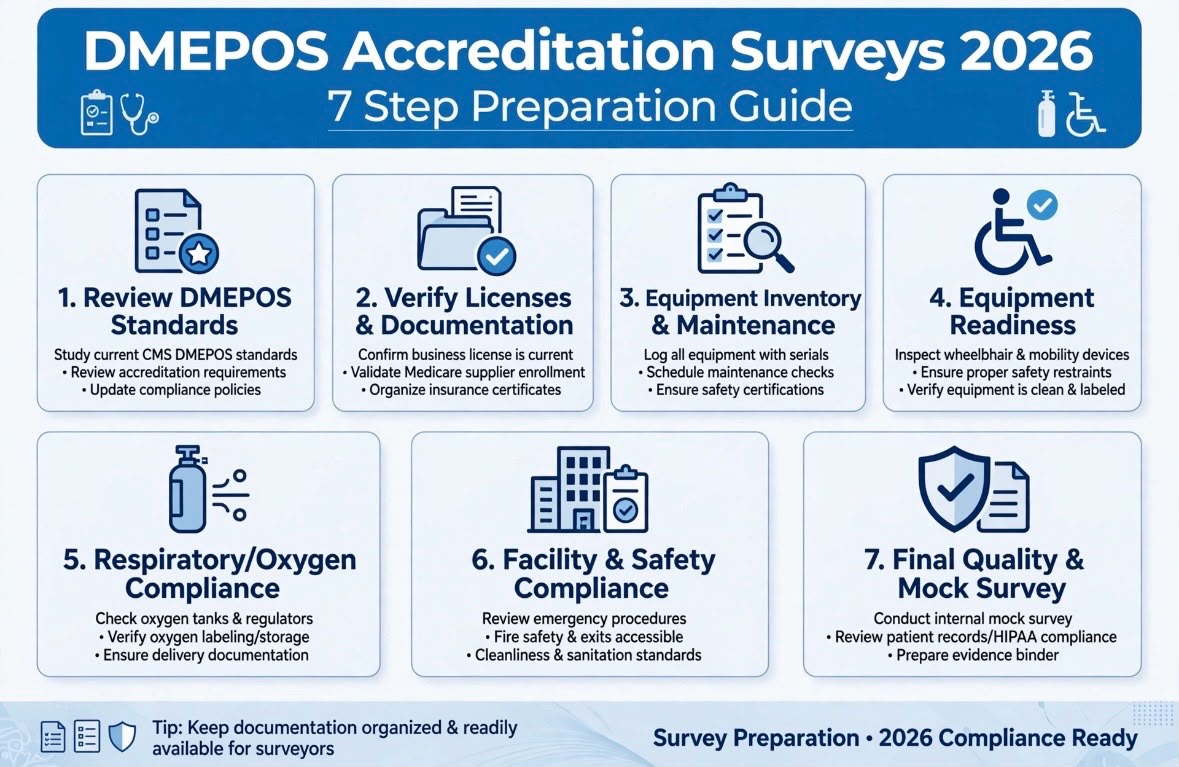
How to Prepare for a DMEPOS Accreditation Survey in 2026
Review Your Current Accreditation Standards
Begin by confirming the current requirements that apply to your supplier and accreditation scope. Do not rely exclusively on an old survey checklist.
Conduct a Complete Documentation Audit
Review employee files, beneficiary records, training documentation, policies, complaints, quality records, and other applicable documents. Look specifically for missing information, expired documents, inconsistent entries, and incomplete records.
Update Policies and Procedures
Your policies should accurately reflect how your organization operates today. If your services, employees, location, equipment, or processes have changed, review whether the relevant policies need to be updated.
Verify Staff Training
Maintain clear evidence of employee training and competency where required. Employees should also be familiar with the policies they are expected to follow.
Review Complaints and Corrective Actions
Make sure complaints, incidents, deficiencies, and corrective actions are properly documented. If a problem was identified previously, be prepared to show what was done to address it.
Perform a Mock Survey
A mock survey is one of the most practical ways to identify weaknesses. Review your operations as an accreditation surveyor would and ask employees questions about their daily responsibilities.
Common Problems Found During Accreditation Preparation
Suppliers frequently create avoidable risks by overlooking small compliance details. Common problem areas include:
- Outdated policies and forms
- Missing employee training records
- Incomplete beneficiary documentation
- Inconsistent information across records
- Poorly organized compliance files
- Inadequate complaint tracking
- Missing corrective-action evidence
- Employees unfamiliar with written procedures
- Quality activities that are not properly documented
Addressing these issues before a survey can make the accreditation process more manageable and reduce last-minute pressure.
Build a Year-Round Accreditation Readiness Program
The strongest approach to DMEPOS annual accreditation surveys is to make compliance part of routine management.
Instead of conducting one large review every year, suppliers can schedule periodic internal audits, review policies at appropriate intervals, monitor employee training, evaluate complaints, and track corrective actions.
This approach helps identify problems earlier and creates a stronger record of ongoing compliance.
Final Thoughts
DMEPOS accreditation surveys in 2026 should be approached as an ongoing compliance responsibility rather than a once-a-year inspection. Suppliers that maintain organized documentation, train employees, review policies, monitor quality, and correct deficiencies promptly are better positioned for a successful survey.
The most effective preparation is simple: stay survey-ready before the survey is scheduled.
FAQs
What does a DMEPOS accreditation survey evaluate?
A survey may evaluate policies, beneficiary services, employee training, documentation, quality procedures, safety practices, complaints, corrective actions, and other areas applicable to the supplier’s accreditation scope.
What should DMEPOS suppliers do differently in 2026?
Suppliers should verify current applicable standards and place greater practical emphasis on maintaining continuous compliance, accurate documentation, staff awareness, and evidence that policies are consistently implemented.
How can I prepare for a DMEPOS accreditation survey?
Review current requirements, audit records, update policies, verify employee training, review complaints and corrective actions, and conduct a mock survey before the official review.
How important are employee training records?
They can be an important part of demonstrating that employees are qualified, trained, and aware of the procedures relevant to their responsibilities.
What happens if a supplier identifies a compliance gap?
The supplier should evaluate the issue, take appropriate corrective action, document the response, and monitor the situation when necessary.
Should DMEPOS suppliers conduct mock surveys?
Yes. A mock survey can help identify documentation gaps and operational weaknesses before the actual accreditation review.