
Running a Medicare DMEPOS business requires more than supplying medical equipment and submitting claims. Suppliers must demonstrate that their operations meet Medicare’s quality and compliance expectations.
In 2026, that responsibility is becoming even more significant as DMEPOS accreditation moves toward more frequent oversight.
For suppliers, the key is understanding what accreditation actually covers, what needs to be maintained throughout the year, and how changes to products or locations can affect compliance.
What Does DMEPOS Accreditation Actually Mean?
DMEPOS accreditation is an independent evaluation of a supplier’s ability to meet applicable Medicare standards for the products and services it provides.
DMEPOS includes:
- Durable medical equipment
- Prosthetics
- Orthotics
- Medical supplies
Accreditation is generally obtained through a CMS-approved accreditation organization.
But accreditation should not be confused with Medicare enrollment itself. A supplier needs to satisfy the applicable requirements across accreditation, enrollment, licensing, operations, and quality standards.
The Biggest DMEPOS Compliance Change in 2026
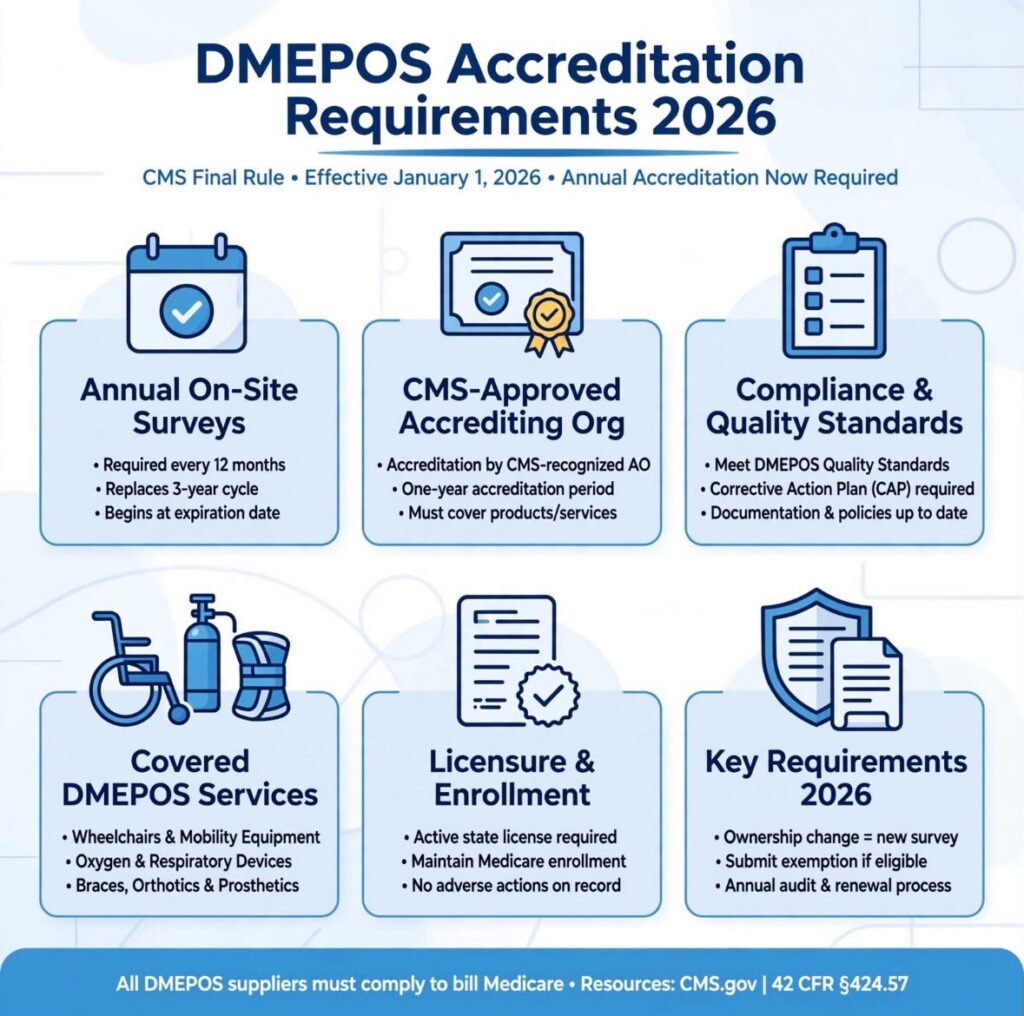
The biggest issue suppliers need to understand is the shift toward more frequent accreditation surveys.
CMS’s updated requirements move accredited suppliers toward surveys and reaccreditation at least every 12 months after their existing accreditation term expires.
For businesses that have historically prepared for accreditation only once every few years, this represents a major operational change.
Why Annual Oversight Changes the Strategy
A supplier can no longer rely on a large preparation project every few years.
Instead, compliance should be maintained throughout the year.
That means reviewing documentation, training, licensing, product categories, locations, and policies regularly.
Start With the Right Accreditation Organization
The accreditation process begins with selecting a CMS-approved accreditation organization.
Suppliers should not choose an accreditor solely based on price or convenience.
The organization should be able to evaluate the supplier’s specific DMEPOS operations and applicable product categories.
Questions to Ask Before Choosing an Accreditor
Ask the accreditation organization:
- Is your DMEPOS program currently CMS-approved?
- Which product categories do you accredit?
- How are new locations handled?
- What happens when a supplier adds a product category?
- How are surveys conducted?
- What documentation is required?
- What is the reaccreditation process?
Getting these answers before applying can prevent avoidable complications.
Accreditation Is Product-Specific
A DMEPOS supplier should know exactly what its accreditation covers.
Adding products without checking accreditation scope can create a compliance gap.
For example, if a supplier expands into a new category, the supplier may need to notify its accreditor and complete additional review or survey requirements.
Create a Product Accreditation Matrix
A simple internal chart can list:
- Product Category
- Accredited?
- State License
- Staff Training
- Review Needed
Location Compliance Is Just as Important
A supplier’s physical locations are a major part of DMEPOS compliance.
Opening a new site should trigger a compliance review before the business begins Medicare operations from that location.
Under the updated rules, new locations must be surveyed before accreditation is granted.
New Location Planning Should Include
- Facility: Is the location appropriate for the supplier’s operations?
- Licensing: Are all applicable state and local licenses available?
- Enrollment: Does Medicare enrollment information reflect the location?
- Accreditation: Is the location properly included in the accreditation process?
- Staff: Are employees trained for the services being provided?
- Documentation: Are required records and procedures ready?
A rushed location opening can create problems that are much harder to fix later.
State Licensing Must Be Monitored Separately
Medicare accreditation does not replace state licensing.
DMEPOS suppliers should identify every state in which they operate or provide applicable products and determine what licensing requirements apply.
A supplier should never assume that one state license covers another state.
Build a State-by-State Compliance File
For each state, document:
- Applicable license
- License number
- Products covered
- Effective date
- Expiration date
- Renewal requirements
- Responsible person
This is particularly important for suppliers operating across multiple states.
Keep PECOS and Medicare Information Current
A DMEPOS supplier can be properly accredited and still experience problems if its Medicare enrollment information is outdated.
Suppliers should review information relating to:
- Business address
- Practice locations
- Ownership
- Products and services
- Contact information
- Accreditation
- Licensing
When the business changes, Medicare enrollment information should be reviewed rather than assuming the existing record remains correct.
What Happens During a DMEPOS Accreditation Survey?
An accreditation survey is designed to evaluate whether the supplier actually operates according to applicable requirements.
A survey may involve reviewing:
- Business policies
- Patient records
- Delivery documentation
- Employee credentials
- Training records
- Equipment processes
- Quality improvement activities
- Complaint management
- Safety procedures
- Physical operations
Because DMEPOS accreditation involves an on-site survey, suppliers should keep their facilities and documentation survey-ready.
Why Unannounced Surveys Matter
An unannounced survey means the supplier cannot depend on a short preparation window.
This makes everyday compliance especially important.
Employees should know where policies are located. Records should be organized before a surveyor arrives. Licenses should be current. Required documentation should not be created at the last minute.
Build a Strong DMEPOS Compliance Program
A strong compliance program has several layers.
Layer 1: Written Policies
Policies should clearly explain how the company handles important operational and patient-care processes.
Layer 2: Employee Training
Employees should be trained on the policies relevant to their responsibilities.
Layer 3: Documentation
The supplier should retain evidence showing that required processes actually occurred.
Layer 4: Internal Auditing
Management should periodically test whether policies are being followed.
Layer 5: Corrective Action
Problems should be documented, assigned to responsible employees, corrected, and followed up.
This structure makes compliance an ongoing business process rather than a paperwork exercise.
What Documents Should DMEPOS Suppliers Keep Ready?
The exact documentation depends on the supplier’s operations and accreditation program, but businesses should generally maintain organized records relating to:
- Accreditation
- Licenses
- Employee qualifications
- Training
- Patient services
- Equipment
- Deliveries
- Complaints
- Incidents
- Quality improvement
- Policies and procedures
- Medicare enrollment
The key is accessibility. If a required document exists but cannot be located quickly, it can still create an unnecessary compliance problem.
How to Prepare for DMEPOS Accreditation in 2026
Start preparation well before the survey.
Step 1: Review Your Accreditation Scope
Make sure it matches your current products and services.
Step 2: Audit Every Location
Confirm that each location meets applicable requirements.
Step 3: Check Licenses
Review expiration dates and renewal requirements.
Step 4: Review Employee Files
Confirm training and qualification documentation is complete.
Step 5: Audit Patient Records
Look for missing or inconsistent documentation.
Step 6: Test Your Policies
Ask employees to explain how important procedures work in practice.
Step 7: Conduct a Mock Survey
Walk through the facility and documentation as if an accreditation surveyor were arriving.
Step 8: Correct Deficiencies
Do not wait until the official survey to address known problems.
What Can Cause DMEPOS Compliance Problems?
Several recurring issues deserve attention.
Expired Accreditation
A supplier should know exactly when its accreditation term ends and plan accordingly.
Incorrect Product Scope
Adding products without confirming accreditation coverage can create compliance concerns.
Unlicensed Operations
State licensing requirements must be tracked separately.
Incomplete Documentation
Missing records can make it difficult to demonstrate compliance.
Untrained Employees
Staff should understand the policies and procedures relevant to their roles.
Outdated Enrollment Information
Changes in business operations should prompt a review of Medicare enrollment information.
A 2026 DMEPOS Self-Audit Checklist
Use this quick review before an accreditation survey:
- ☐ Accreditation organization is CMS-approved.
- ☐ Accreditation scope matches current services.
- ☐ Product categories have been reviewed.
- ☐ All locations have been evaluated.
- ☐ State licenses are current.
- ☐ PECOS information is accurate.
- ☐ Employee files are complete.
- ☐ Training records are updated.
- ☐ Patient records are organized.
- ☐ Delivery documentation is available.
- ☐ Complaint records are maintained.
- ☐ Quality improvement activities are documented.
- ☐ Policies match actual business practices.
- ☐ Internal audits are completed.
- ☐ Staff are prepared for an unannounced survey.
How Can Suppliers Stay Compliant After Accreditation?
Passing a survey should not be considered the finish line.
After accreditation, suppliers should continue monitoring compliance.
Set recurring calendar reminders for:
- License renewals
- Policy reviews
- Employee training
- Internal audits
- Product-scope reviews
- Location reviews
- Medicare enrollment updates
- Accreditation deadlines
This creates a continuous compliance cycle that is much easier to manage than repeated emergency preparation.
Final Takeaway
DMEPOS accreditation in 2026 is increasingly about continuous readiness.
Medicare suppliers need to look beyond the accreditation certificate and manage the entire compliance picture—from product categories and locations to licensing, employee training, documentation, and Medicare enrollment.
The suppliers most likely to navigate the 2026 requirements successfully are those that make compliance part of their normal operations rather than something they address only when a survey is approaching.
FAQs
What are the main DMEPOS accreditation requirements in 2026?
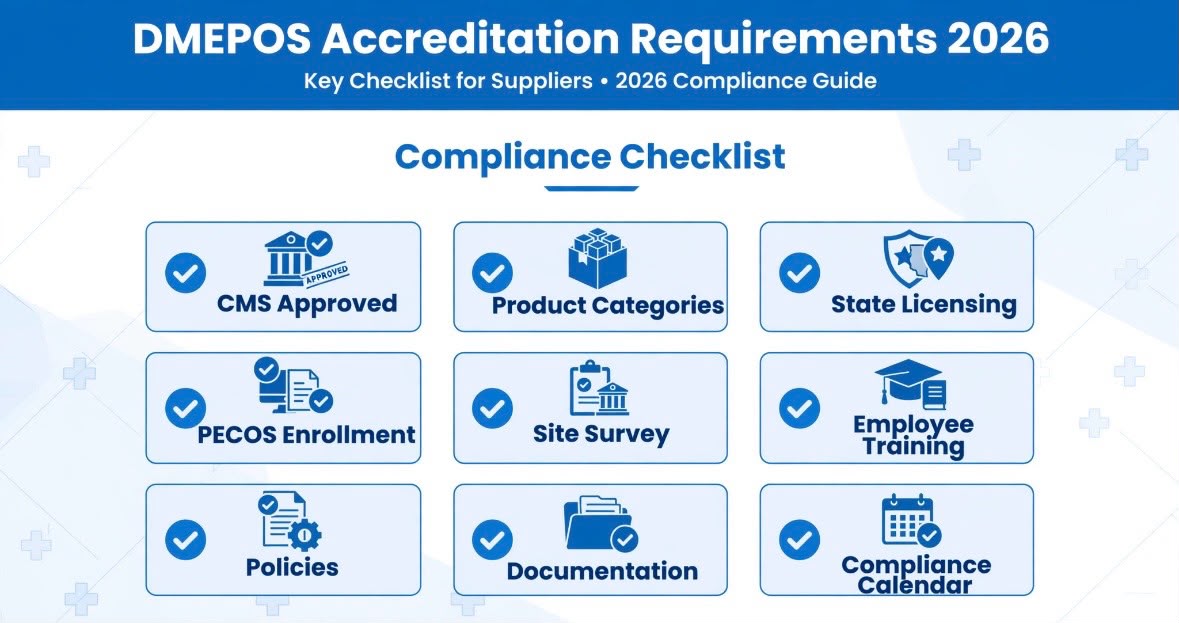
Key areas include CMS-approved accreditation, applicable product-category coverage, compliant locations, state licensing, Medicare enrollment, quality standards, documentation, and survey readiness.
Is DMEPOS accreditation the same as Medicare enrollment?
No. Accreditation is an important requirement for many DMEPOS suppliers, but Medicare enrollment involves additional requirements and information.
How often will DMEPOS accreditation be reviewed?
CMS’s updated framework moves suppliers toward at least annual survey and reaccreditation oversight after their existing accreditation term expires.
Can a DMEPOS supplier change locations without updating accreditation?
Suppliers should notify their accreditation organization and review applicable Medicare requirements before moving or adding a location. New locations may require an on-site survey.
What if a supplier adds a new DMEPOS product?
The supplier should first confirm that the product is covered by its existing accreditation scope. Additional review or accreditation may be necessary.
What is the best way to prepare for an accreditation survey?
Maintain continuous compliance, conduct internal audits, keep documentation organized, train employees, and perform a mock survey before the accreditation visit.
Why is documentation important for DMEPOS accreditation?
Documentation provides evidence that the supplier follows required policies and procedures and can help demonstrate compliance during a survey.