
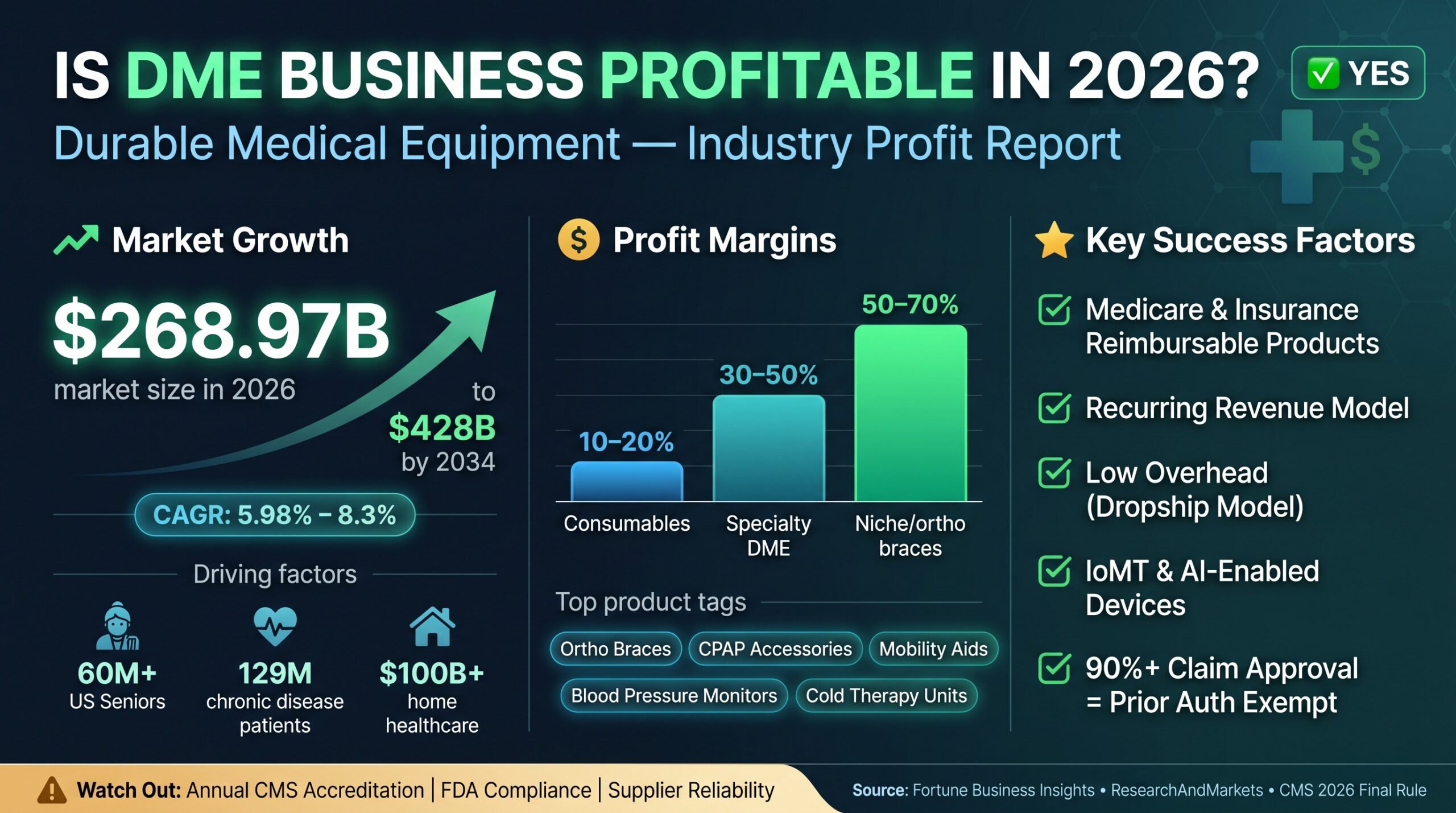
The DME space looks attractive in 2026 because demand is still rising, home-based care keeps expanding, and the market outlook remains positive. That is why many suppliers and investors are asking whether DME business profitable in 2026 is still the right question to pursue. The answer is yes for many businesses, but only when the model is built carefully. Competitor sources point to the same pattern. Growth is real, but profit depends on compliance, payer access, documentation, and product strategy. Fortune Business Insights projects the global durable medical equipment market to grow from $268.97 billion in 2026 to $428.08 billion by 2034, while CMS continues to publish active 2026 DMEPOS fee schedules for covered items. That means opportunity is still there, but it rewards operators who understand the system and manage it well.
Why the DME market still looks strong in 2026
One reason this business still gets attention is market growth. Fortune Business Insights says the global durable medical equipment market was valued at $253.79 billion in 2025 and is projected to reach $268.97 billion in 2026, with continued growth through 2034. The Leads Warehouse also says the U.S. DME market outlook remains positive and cites expected annual growth in the 5.0% to 5.6% range over the next several years. Even though its market-size figures appear unusually low compared with other research sources, its overall message still supports continued market expansion.
The basic drivers are easy to understand. More older adults need mobility and support equipment. More patients are being treated at home. More chronic conditions require longer-term equipment use outside hospitals. These trends support continuing demand for products such as mobility aids, respiratory devices, monitoring equipment, and other home-use medical supplies. That is one reason the market remains active for both traditional suppliers and newer models.
Demand alone, though, does not guarantee profit. A growing market can still be difficult for suppliers with weak billing habits, poor compliance, or bad product selection. This is where many businesses struggle. The opportunity is real, but the business works best when operations are disciplined and focused.
Is DME business profitable in 2026 for new suppliers and growing companies?
Yes, it can be profitable, but not by default. Ava Med Supply says dropshipping DME medical supplies can still be profitable in 2026 when businesses use the right strategy, reliable partners, and strong compliance practices. That is a useful point because it applies beyond dropshipping too. In DME, profit depends less on hype and more on execution. A supplier that controls operations, chooses the right category, and follows payer rules has a much better chance to succeed.
This is why DME business profitability often looks strongest in businesses with a narrow focus. Some suppliers concentrate on a few categories and build efficient systems around them. Others try to carry too many product types too early and end up with more denials, more staff confusion, and more wasted overhead. A focused operation often makes it easier to manage documentation, inventory, delivery, and payer expectations. That tends to protect margins better over time. This is an inference based on the compliance and strategy emphasis in the current market sources.
For new suppliers, profit may also take time. CMS continues to maintain active fee schedules and payment structures in 2026, but reimbursement does not remove startup pressure. New businesses may still need to pay for licensing, enrollment, insurance, systems, inventory, and staffing before revenue becomes stable. So the business can absolutely work in 2026, but owners should not expect easy money in the early stage.
What factors affect profit the most in a DME business?
The first major factor is reimbursement. CMS has active January and April 2026 DMEPOS fee schedules, and Noridian’s 2026 update notes that billing staff need to understand updated payment policies effective January 1, 2026. That tells us two things. Revenue is still available, but suppliers must work inside a regulated payment structure. Profit depends on understanding the rates, the codes, and the rules attached to them.
The second major factor is compliance. Ava Med Supply’s 2026 content stresses strong compliance practices as part of profitability, and one related Ava page says providers without proper licensing, NPI setup, Medicare PECOS enrollment, and DMEPOS accreditation risk billing denials and regulatory fines. That means compliance is not just a paperwork issue. It directly affects whether a supplier can bill legally and get paid consistently.
The third factor is documentation and process control. Even when demand is high, a business can lose money through preventable denials, delays, and incomplete files. The current CMS fee schedule framework and payer environment make accuracy important because the supplier cannot simply raise prices to fix sloppy operations. Strong documentation, correct billing, and current code knowledge matter because they protect the path from order to payment. This is an inference grounded in the CMS and Noridian updates.
The fourth factor is market model. Ava Med Supply’s article focuses on dropshipping and highlights advantages such as avoiding warehouse and shipping burdens, but it also ties success to reliable partners and compliance. That suggests some business models can reduce overhead, though they still require careful control and legal readiness. In other words, the model can improve efficiency, but it does not remove the need for discipline.
How to improve profit and reduce risk in 2026
The best first step is to choose a clear niche. A supplier that tries to do everything at once may spread itself too thin. A more focused category mix can make training, billing, partner management, and customer service easier to handle. This is especially useful in a market where reimbursement rules and compliance expectations remain active and detailed.
The next step is to build around reliable systems. Ava Med Supply says profitability in 2026 depends on strategy, reliable partners, and strong compliance. That advice matters because DME success often depends on what happens after the sale or referral comes in. If documentation breaks down, if partners are weak, or if fulfillment is inconsistent, margins can fall quickly even in a growing market.
It also helps to stay current with market changes. CMS continues publishing 2026 fee schedule files, and contractors such as Noridian are issuing updates tied to effective dates and policy implementation. A supplier that does not watch those updates may lose money through outdated billing practices or missed payment details. Staying current is a simple habit, but it can protect profit more than many owners realize.
In the end, this is still a promising business in 2026, but it is not automatic. Market growth is real, payer systems are active, and home-based care continues to support long-term demand. The most profitable suppliers are usually the ones that stay focused, compliant, and operationally sharp. For owners who build carefully and manage the details well, the answer is yes: this can still be a profitable business in 2026