
Starting a Durable Medical Equipment (DME) business involves more than obtaining inventory and finding customers. To legally bill Medicare and operate as a compliant supplier, business owners must complete several regulatory requirements. Two of the most commonly misunderstood requirements are DME Accreditation and NPPES enrollment.
Many new suppliers assume that obtaining an NPI through NPPES automatically qualifies them to bill Medicare. Others believe accreditation alone is enough to begin operations. In reality, these are two completely different processes, and both play critical roles in the Medicare enrollment journey.
Understanding the distinction between DME Accreditation and NPPES can save business owners significant time, prevent costly delays, and improve the chances of successful Medicare enrollment.
In this guide, All State DME Consultants explains what each requirement means, why they matter, and how they work together to help your DME business become Medicare-compliant.
What Is DME Accreditation?
DME Accreditation is a formal evaluation process conducted by a CMS-approved accrediting organization to verify that a Durable Medical Equipment supplier meets Medicare quality standards.
The accreditation process examines multiple areas of business operations, including:
- Patient care policies
- Product management procedures
- Billing compliance
- Staff qualifications
- Safety protocols
- Business operations and documentation
The purpose of accreditation is to ensure that Medicare beneficiaries receive high-quality products and services from qualified suppliers.
Why DME Accreditation Matters
Medicare generally requires DME suppliers to obtain accreditation before enrolling as a Medicare supplier.
Benefits of accreditation include:
- Eligibility to participate in Medicare programs
- Improved business credibility
- Enhanced compliance standards
- Better operational efficiency
- Increased trust among referral sources and patients
Without accreditation, most DME suppliers cannot complete Medicare enrollment requirements.
What Is NPPES?
NPPES stands for National Plan and Provider Enumeration System.
It is the system used by CMS to issue National Provider Identifiers (NPIs) to healthcare providers and organizations.
An NPI is a unique 10-digit identification number used for:
- Medicare enrollment
- Healthcare transactions
- Insurance claims processing
- Provider identification
Every DME supplier seeking Medicare enrollment must obtain an NPI through NPPES.
Why NPPES Is Important
The NPI serves as your business identifier throughout the healthcare system.
It allows Medicare, commercial insurers, and healthcare partners to identify your organization accurately.
However, obtaining an NPI does not mean your business is accredited or approved to bill Medicare.
DME Accreditation vs NPPES: The Main Difference
The simplest way to understand the difference is:
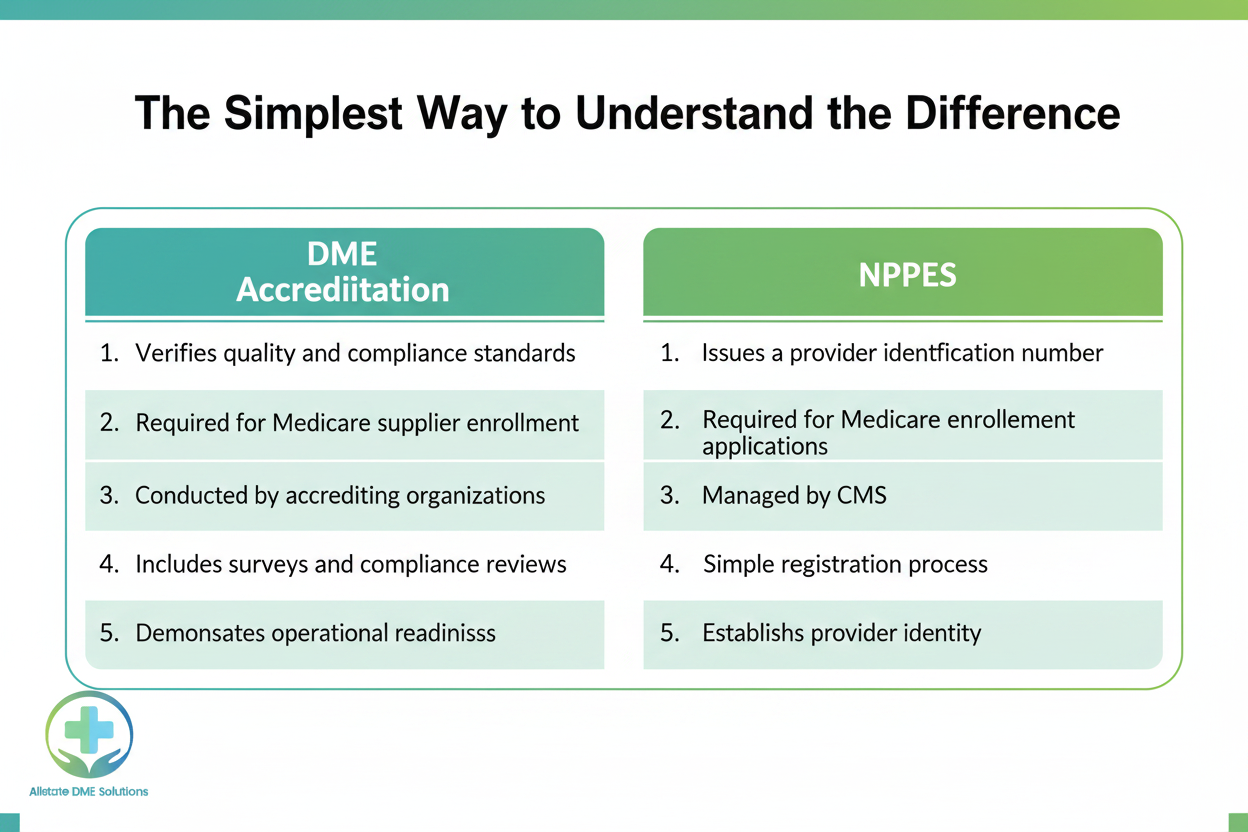
In short:
Accreditation proves your business meets Medicare standards.
NPPES provides your business with an NPI number.
You typically need both before becoming an active Medicare supplier.
How DME Accreditation and NPPES Work Together
A successful Medicare enrollment generally follows this sequence:
Step 1: Establish Your Business
Create your legal business entity and obtain:
- EIN
- State registrations
- Business licenses
- Physical location
Step 2: Obtain an NPI Through NPPES
Register your organization and receive your National Provider Identifier.
Step 3: Complete DME Accreditation
Prepare policies, procedures, documentation, and undergo the accreditation survey process.
Step 4: Obtain a Surety Bond
Most suppliers are required to maintain a Medicare surety bond.
Step 5: Submit Medicare Enrollment
Complete CMS enrollment requirements using your NPI and accreditation documentation.
Challenges New DME Suppliers Face
Many suppliers encounter obstacles such as:
- Incorrect NPI registration
- Missing accreditation documents
- Incomplete compliance policies
- Survey preparation issues
- Medicare application errors
- Delayed approvals
Working with experienced DME consultants can significantly reduce these risks.
How All State DME Consultants Helps
At All State DME Consultants, we guide suppliers through every stage of the enrollment process.
Our services include:
DME Accreditation Services
- Policy and procedure development
- Accreditation preparation
- Mock surveys
- Documentation review
- Compliance consulting
Medicare Enrollment Assistance
- PECOS registration support
- Application preparation
- Compliance guidance
- Ongoing enrollment support
NPPES Registration Assistance
- NPI application support
- Data verification
- Enrollment coordination
Our goal is to help DME suppliers achieve compliance faster while avoiding common mistakes that delay approval.
Why Compliance Matters in 2026 and Beyond
Healthcare regulations continue to evolve.
CMS places increasing emphasis on:
- Supplier accountability
- Quality standards
- Documentation accuracy
- Fraud prevention
- Patient safety
Suppliers that maintain strong compliance systems are better positioned for long-term success.
Investing in proper accreditation and enrollment support today can help protect your business from future regulatory challenges.
Final Thoughts
Understanding the difference between DME Accreditation and NPPES is essential for every Medicare supplier.
While NPPES provides the National Provider Identifier needed for healthcare transactions, DME Accreditation demonstrates that your business meets Medicare quality standards. Neither process replaces the other, and both are typically required for successful Medicare enrollment.
For suppliers looking to simplify the process, avoid delays, and achieve compliance with confidence, All State DME Consultants provides expert guidance every step of the way.
Whether you are launching a new DME company or expanding an existing operation, our team can help you navigate accreditation, NPPES registration, and Medicare enrollment efficiently.
Contact All State DME Consultants today to start your path toward Medicare compliance and long-term business success.
FAQs
Q1: Is DME accreditation required before Medicare enrollment?
Yes. Most DME suppliers must obtain accreditation from a CMS-approved accrediting organization before Medicare enrollment.
Q2: What is NPPES used for?
NPPES issues National Provider Identifiers (NPIs) used for healthcare transactions and Medicare enrollment.
Q3: Does obtaining an NPI mean I can bill Medicare?
No. You must complete Medicare enrollment and meet all supplier requirements.
Q4: Can I apply for accreditation before getting an NPI?
Yes, but obtaining your NPI early often helps streamline the enrollment process.
Q5: How long does DME accreditation take?
Timelines vary based on preparedness, documentation quality, and accrediting organization requirements.