
Running a successful DMEPOS business involves more than supplying medical equipment and processing Medicare claims. Suppliers must maintain strict operational, administrative, and regulatory standards to remain eligible for Medicare reimbursement.
Some compliance risks are easy to recognize, while others develop behind the scenes. Inconsistent employee training, poorly managed supplier records, overlooked renewal dates, and ineffective billing controls can gradually weaken a company’s compliance position.
For DMEPOS suppliers, identifying these issues early is essential to protecting Medicare billing privileges and maintaining long-term business stability.
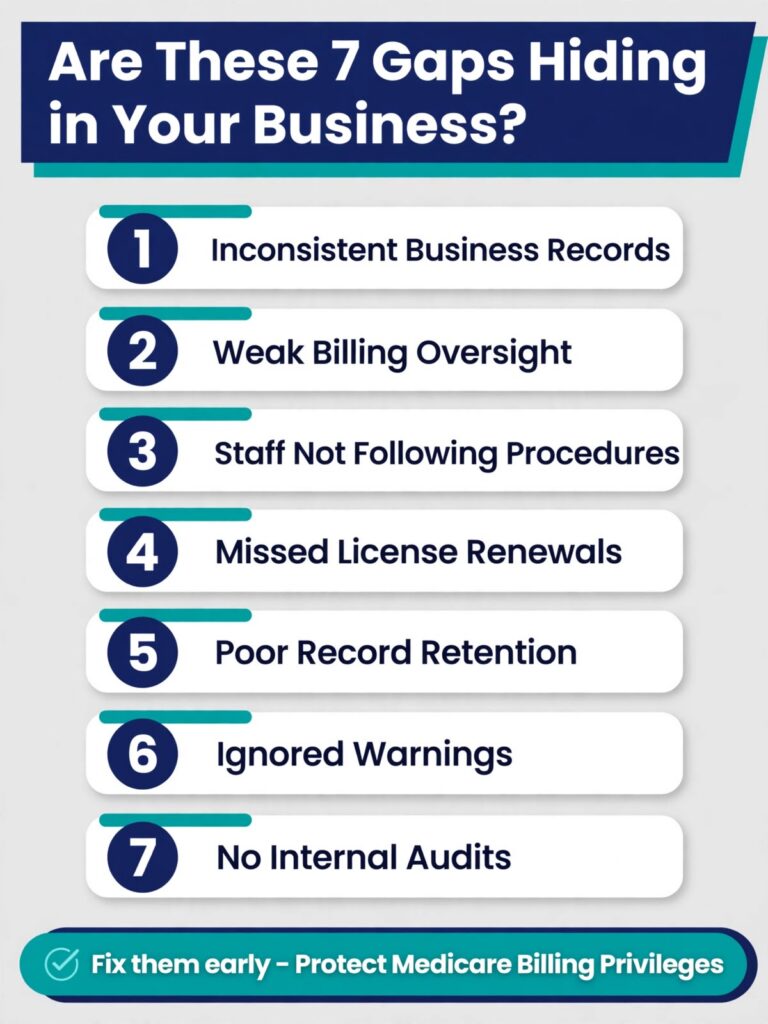
1. Inconsistent Business Records and Enrollment Details
Accurate business information is a fundamental Medicare enrollment requirement. However, suppliers sometimes overlook the importance of keeping internal records consistent with their official enrollment information.
For example, a business may update its office address internally but fail to submit the required enrollment update. Similarly, ownership changes or management updates may not be reflected in PECOS.
These inconsistencies can create problems during enrollment reviews and site visits.
How to address this gap:
- Compare internal business records with PECOS information.
- Review ownership and management details.
- Update reportable enrollment information within required timeframes.
- Maintain supporting documents for business changes.
2. Inadequate Billing and Claims Oversight
Billing mistakes can become serious compliance concerns when suppliers do not have effective review procedures.
Incorrect billing codes, unsupported claims, missing documentation, and inaccurate beneficiary information can expose a business to payment denials, audits, and potential enforcement actions.
DMEPOS suppliers should implement a structured claims review process that includes:
- Verifying beneficiary eligibility.
- Reviewing orders and supporting medical records.
- Checking applicable coverage requirements.
- Confirming correct coding.
- Maintaining proof of delivery.
- Investigating unusual billing patterns.
A consistent review process helps businesses identify errors before claims are submitted.
3. Employees Not Following Compliance Procedures
Employees play an important role in maintaining Medicare compliance. Even when management understands federal requirements, inadequate staff training can lead to repeated operational mistakes.
For instance, employees may not understand documentation requirements, proper patient communication, recordkeeping procedures, or how to handle Medicare information requests.
Suppliers should provide regular training based on employee responsibilities.
Training programs should cover Medicare supplier standards, documentation procedures, billing practices, patient service expectations, and internal reporting processes.
4. Missing Accreditation and License Renewal Deadlines
Accreditation and licensing requirements must be monitored throughout the life of a DMEPOS business.
A supplier that overlooks an accreditation renewal or fails to maintain an applicable state license may face enrollment and operational challenges.
This issue becomes more complicated when a business operates in multiple states or has several locations with different licensing requirements.
Practical compliance measures include:
- Creating a centralized renewal calendar.
- Assigning responsibility for license monitoring.
- Tracking accreditation survey dates.
- Maintaining copies of current certificates.
- Reviewing state-specific requirements regularly.
5. Inadequate Record Retention and Document Access
Maintaining records is not enough if employees cannot locate them when needed.
Medicare may request supporting documentation to evaluate claims and verify supplier compliance. Missing or disorganized records can delay responses and create unnecessary risks.
Suppliers should maintain organized digital or physical recordkeeping systems that allow authorized staff to retrieve required documents efficiently.
For applicable DMEPOS claims, CMS documentation guidance includes proof of delivery retention for seven years from the date of service.
Businesses should establish clear procedures for storing, protecting, and retrieving patient and billing records.
6. Ignoring Compliance Warnings and Corrective Actions
Another hidden risk is failing to address identified deficiencies.
Some suppliers receive audit findings, accreditation recommendations, or requests for additional documentation but do not establish a clear corrective action process.
Ignoring recurring issues can allow the same weaknesses to affect multiple areas of the business.
A corrective action process should identify the original problem, determine its cause, assign responsibility, establish a completion deadline, and document the results.
Suppliers should also verify that corrective actions are effective rather than simply marking issues as resolved.
7. Lack of Routine Internal Compliance Audits
Waiting for an external inspection to identify problems is a risky approach to compliance management.
Internal audits allow DMEPOS suppliers to evaluate their operations before issues become more serious.
An effective internal audit may examine:
- Medicare enrollment accuracy.
- Accreditation status.
- State licensing requirements.
- Patient documentation.
- Billing and claims procedures.
- Proof of delivery records.
- Employee training.
- Business location compliance.
The findings should be documented and followed by appropriate corrective actions.
Building a Stronger Medicare Compliance Strategy
A sustainable compliance strategy should combine management oversight, employee accountability, accurate documentation, and regular monitoring.
DMEPOS suppliers can strengthen their compliance programs by assigning clear responsibilities, establishing written procedures, reviewing regulatory updates, and maintaining organized records.
Working with experienced DMEPOS compliance consultants can also help suppliers identify operational weaknesses, prepare for accreditation surveys, and improve their understanding of Medicare enrollment requirements.
However, consulting support should complement—not replace—the supplier’s responsibility to maintain compliance.
Conclusion
The greatest compliance risks are not always obvious. Small administrative oversights, inconsistent records, inadequate training, and weak billing controls can create problems that affect a DMEPOS supplier’s ability to maintain Medicare participation.
By implementing regular internal audits, monitoring accreditation and licensing requirements, and strengthening documentation practices, suppliers can reduce avoidable compliance risks.
A proactive compliance strategy helps protect Medicare billing privileges while supporting a more reliable and sustainable DMEPOS business.
Frequently Asked Questions (FAQs)
1. What are the most common hidden compliance gaps for DMEPOS suppliers?
Common gaps include outdated enrollment information, missing patient documentation, expired licenses, accreditation issues, billing errors, and inadequate employee training.
2. What happens if a DMEPOS supplier violates Medicare supplier standards?
Depending on the violation and applicable regulations, CMS may take enforcement action, including revocation of Medicare billing privileges.
3. Why are internal compliance audits important?
Internal audits help identify documentation errors, enrollment discrepancies, and operational weaknesses before they develop into more serious problems.
4. How can employee training improve DMEPOS compliance?
Training helps employees understand Medicare requirements, follow proper documentation procedures, and perform their responsibilities consistently.
5. How long should DMEPOS suppliers retain proof of delivery?
CMS guidance states that suppliers must retain proof of delivery for seven years from the date of service.
6. Can a DMEPOS compliance consultant help prevent Medicare revocation?
A qualified consultant can help identify compliance gaps, review operational procedures, and support accreditation and enrollment readiness. Suppliers remain responsible for meeting Medicare requirements.