
Choosing a DME consulting company is not a small decision. It can shape how fast your business opens, how well it stays compliant, and how confidently it grows. A good consultant does more than answer questions. They help you avoid expensive mistakes before those mistakes reach your applications, surveys, billing, or payer relationships. Many DME owners start with strong motivation, yet they quickly face rules that feel scattered and hard to follow. Accreditation, Medicare enrollment, documentation, billing, product selection, and site readiness all need attention. The right consulting partner turns that confusion into a clear path. This guide explains how to compare companies with care and choose support that fits your business goals.
Why Choosing the Right DME Consultant Matters
A durable medical equipment business runs within a regulated healthcare space. That means growth depends on more than sales. Your company must meet supplier standards, prepare for accreditation, enroll with payers, manage claims, and maintain clean records.
A weak consultant may give general advice that does not match your situation. That can lead to delays, denied applications, failed inspections, or poor billing setup. A strong consultant looks at your exact business model. They help you understand what must happen first and what can wait.
This matters most for new suppliers. The early stage is where many owners make costly decisions. They may sign the wrong lease, choose products too early, or buy software before they know their payer’s needs. A consultant should help you avoid those moves.
Existing suppliers also need careful support. You may already have revenue but still struggle with denials, compliance gaps, staff training, or payer access. The right company can review your current process and find the weak points that limit growth.
Good consulting helps you move faster because the path is clearer. It also helps you move more safely because compliance stays part of each decision.
Start With Your Business Needs
Before comparing companies, define what you need. Some DME businesses need help with startup planning. Others need accreditation support, Medicare enrollment, billing improvement, or operational cleanup.
A startup may need help with business formation, product category planning, site readiness, policies, applications, and payer setup. An existing supplier may need support with audits, survey readiness, denials, documentation, or expansion.
Do not choose a company only because it sounds experienced. Choose one that solves the problem you actually have. If your main issue is credentialing, you need a team that understands payer enrollment. If your main issue is survey preparation, you need accreditation experience. If your main issue is slow payments, billing, and documentation, support matters more.
This is where the DME consulting company selection should begin. Start with your business stage, your biggest risk, and your most urgent goal. A clear need makes the choice easier.
You should also decide how much support you want. Some owners need full-service guidance. Others only need a review, a checklist, or a short-term project. A good consultant should be honest about the level of support that fits your situation.
Check Their DME Industry Experience
DME consulting is not the same as general healthcare consulting. The DME field has its own supplier standards, billing rules, accreditation expectations, and product-specific challenges. A consultant with broad healthcare knowledge may still miss important DME details.
Ask how long the company has worked with DME suppliers. Ask what types of businesses they support. Some consultants work with pharmacies, adding DMEPOS. Some work with startup suppliers. Others work with established companies that need compliance or billing improvement.
Experience should be practical, not just promotional. Look for signs that the company understands real operations. They should know about site readiness, policies, staff training, documentation, payer rules, and product category planning. They should also understand how one decision affects another.
For example, product selection can affect accreditation scope. The accreditation scope can affect payer enrollment. Payer access can affect revenue timing. Billing setup can affect cash flow. A useful consultant sees those connections.
Ask for examples of problems they have helped solve. You do not need private client details. You only need to know whether they have handled situations like yours.
Review Their Accreditation and Compliance Knowledge
Accreditation is a major part of many DME business plans. Suppliers that want Medicare billing privileges often need accreditation from a CMS-approved organization. That process requires policies, procedures, records, staff readiness, and operational standards.
A consultant should know how accreditation works. They should understand how to prepare their business before the survey. They should also help you avoid treating accreditation as a one-time task. Compliance continues after approval.
Ask which accrediting bodies they are familiar with. Ask how they help clients prepare for surveys. Ask whether they provide policy support, staff guidance, and mock readiness reviews. These answers show whether they understand the details.
Compliance knowledge should also cover daily business behavior. A DME supplier needs proper documentation, delivery records, complaint handling, patient communication, and ongoing record retention. These details may not feel exciting, but they protect your billing privileges and reputation.
A consultant should explain compliance in simple language. If they use confusing terms without practical steps, that may become a problem later. You need guidance that your team can follow.
Look at Credentialing and Payer Enrollment Support
Credentialing and payer enrollment can control how quickly your business starts earning. If applications are delayed or incomplete, revenue may be delayed too. That can be painful for new suppliers with rent, staff, software, and inventory costs.
A strong consulting company should understand the enrollment process. They should help organize documents, complete forms accurately, and track application progress. They should also explain what each payer may need before approval.
Medicare enrollment can be especially detailed. Suppliers may need proper accreditation, NPI setup, ownership information, business details, insurance, and accurate application records. Commercial payer contracts may bring their own requirements.
Ask the consultant how they manage timelines. Ask whether they help with follow-ups. Ask what they do if an application is returned or delayed. A company that has a process for problems is usually more useful than one that only submits forms.
You should also ask which payers make sense for your business. Not every contract is worth chasing. Some may offer weak rates or difficult rules. A consultant should help you think about payer quality, not just payer quantity.
Evaluate Billing and Documentation Support
DME billing can become a major growth blocker. A supplier may have good demand but poor collections. Claims may get denied because documents are incomplete, codes are wrong, or payer rules were not followed.
A consulting company should understand the link between documentation and payment. They should know that clean billing starts before the claim is sent. Intake, eligibility checks, prior authorization, order review, delivery proof, and claim submission all matter.
Ask whether the company reviews workflows. Ask if they help create checklists for product categories. Ask whether they train staff on required documentation. These services can reduce denials and improve cash flow.
You should also ask how they handle recurring problems. A good consultant looks for patterns. If the same denial happens again and again, the answer is not more rework. The answer is a better process.
Billing support should be practical. It should help your team understand what to collect, when to collect it, and how to keep records organized.
Compare Their Full Service Range
Some consulting companies focus on one area. Others provide broader support. The right choice depends on your needs.
A startup may benefit from a company that can help with setup, accreditation, credentialing, policies, billing workflows, product planning, and operational structure. An existing supplier may only need targeted help with denials or compliance readiness.
This is where DME consulting services can vary widely. Some companies only advise. Some handle applications. Some train staff. Some provide billing support. Some help with business strategy and growth planning.
Make sure you understand what is included. Do not assume every consultant handles every task. Ask for a clear scope of work before signing anything.
You should also ask what is not included. This prevents confusion later. If payer follow-up, policy customization, staff training, or software support costs extra, you should know early.
A clear service scope protects both sides. It also helps you compare companies more fairly.
Ask About Their Process and Communication Style
A good consultant should have a clear process. They should not make your business feel more confused. You should know what happens first, what comes next, and what information they need from you.
Ask how the engagement begins. Do they review your business model? Do they provide a checklist? Do they create a timeline? Do they assign one contact person? These details matter when deadlines are tight.
Communication style is also important. Some owners need regular calls. Others prefer email updates and checklists. Your consultant should explain how updates will be shared.
Poor communication can turn a good service into a stressful experience. If a company is slow to respond before you hire them, that may continue after payment. Notice how they answer your early questions.
A reliable consultant should be direct. They should tell you what is realistic. They should not promise instant approvals or guaranteed outcomes. In regulated healthcare, honest timelines are more valuable than flashy promises.
Watch for Red Flags Before You Hire
Some warning signs are easy to spot. Be careful with companies that promise guaranteed accreditation, instant payer approval, or effortless Medicare enrollment. No consultant controls every reviewer, surveyor, payer, or regulator.
You should also be cautious if the company cannot explain its process. Vague answers may mean weak systems. A consultant should be able to tell you what steps are involved and what your responsibilities will be.
Another red flag is poor knowledge of your business model. A pharmacy adding DMEPOS has different needs from a new DME supplier. A respiratory-focused company may need different support from a mobility supplier. If the consultant treats all businesses the same, results may suffer.
Lack of transparency is another concern. You should know the cost, scope, timeline, and deliverables. You should also know whether the consultant does the work in-house or passes it to someone else.
Strong consultants do not hide the hard parts. They help you prepare for them.
Review Pricing With Long-Term Value in Mind
Price matters, but cheap consulting can become expensive if it causes delays. A low fee may look attractive at first. It may cost more later if applications fail, policies are weak, or billing problems continue.
Compare pricing based on value. What will the company actually do? Will they save time? Will they reduce risk? Will they help you get ready faster? Will they improve systems that affect cash flow?
Ask whether pricing is fixed or hourly. Ask what happens if the project takes longer than expected. Ask whether revisions, follow-ups, and training are included.
Good consulting should feel like an investment in better decisions. It should help you avoid mistakes that can cost far more than the consulting fee.
This is an important part of DME consulting company selection because the lowest price is not always the safest choice. The best value is the company that helps you move forward correctly.
Make Sure They Understand Growth, Not Just Setup
Some consultants are good at helping a business open. Fewer are good at helping a business grow. If your goal is long-term success, choose a company that understands both.
Growth requires more than approval. It requires payer strategy, referral planning, billing control, staff workflows, inventory management, and compliance discipline. A business can open correctly and still struggle if growth systems are weak.
Ask how the consultant supports businesses after launch. Do they help with operational reviews? Do they guide expansion? Do they help improve billing performance? Do they advise on new product lines or payer opportunities?
A consultant who understands growth will ask deeper questions. They may ask about your target patients, service area, product categories, referral sources, staffing plan, and cash flow goals. These questions show they are thinking beyond paperwork.
Your consultant should help you build a business that can handle more volume without more chaos.
Final Thoughts
Choosing the right consultant can change the path of your DME business. The best company not only helps with forms. It helps you make better decisions, avoid delays, protect compliance, and build systems that support growth.
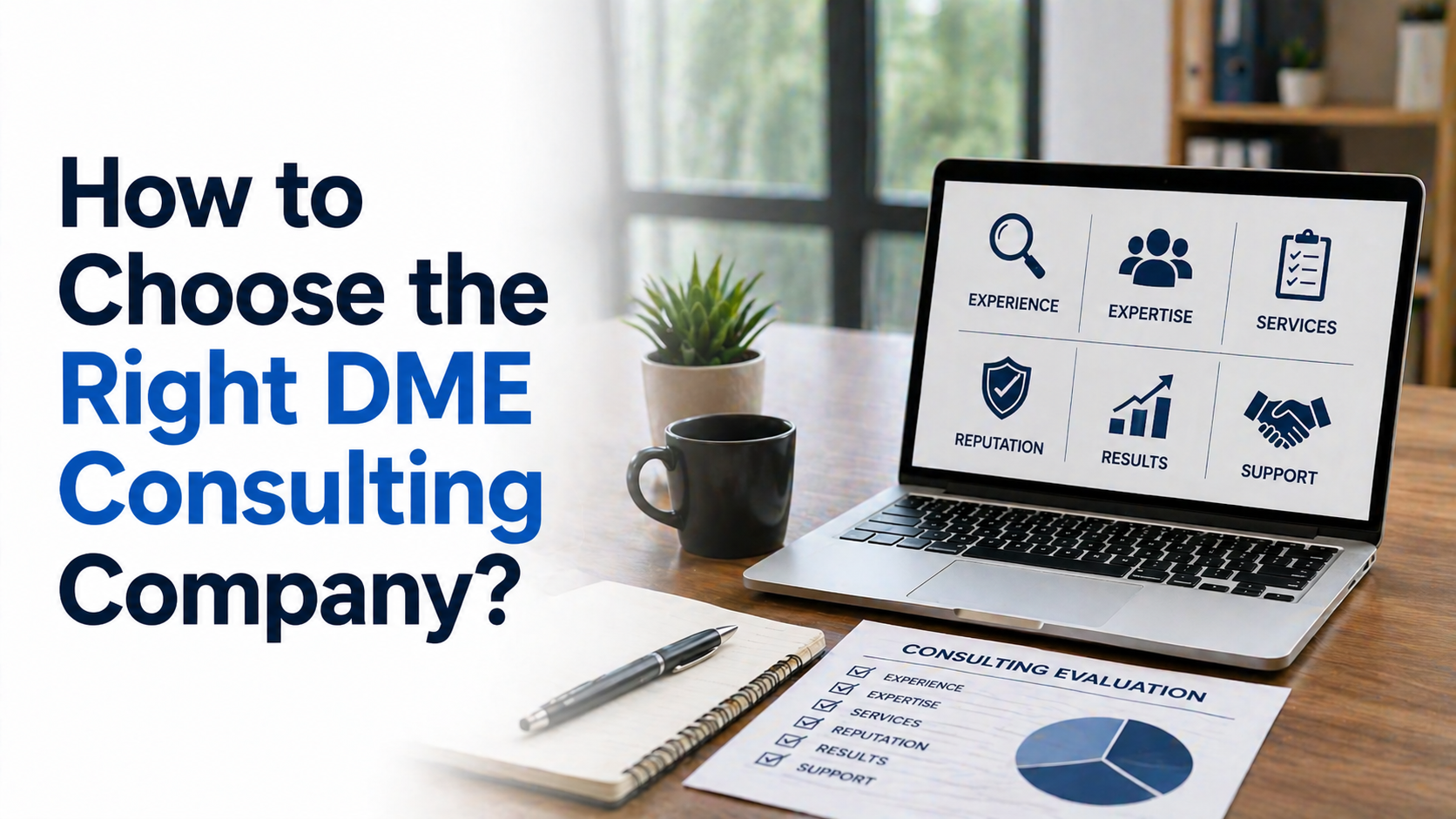
Start by understanding your own needs. Then compare experience, accreditation knowledge, credentialing support, billing expertise, service scope, communication, pricing, and long-term value.
A good consultant should make the process clearer. They should help your team understand what must happen and why it matters. They should also give honest guidance when something needs improvement.
The right choice is not always the largest company or the cheapest offer. The right choice is the team that understands your business stage, your goals, and your risks.
When handled carefully, DME consulting company selection becomes more than vendor research. It becomes a growth decision. The company you choose can help you launch stronger, stay compliant, and build a DME business with fewer costly mistakes.
If your goal is to grow with confidence, take your time before hiring. Ask better questions. Compare real support. Choose the consultant that can guide your business from setup to sustainable success.